Artwork by PattahSee2019
To date, all of my discussions of the total goddess or mother goddess or Great Mother—all terms point to the same entity—have centered on the ways in which women can better relate to her, as a psychological construct, by rewriting the feminine archetypes. This is a process I call self-fashioning, and it has helped me to locate the divine feminine within. Though, to be sure, the lessons of the Great Mother aren’t just for women.
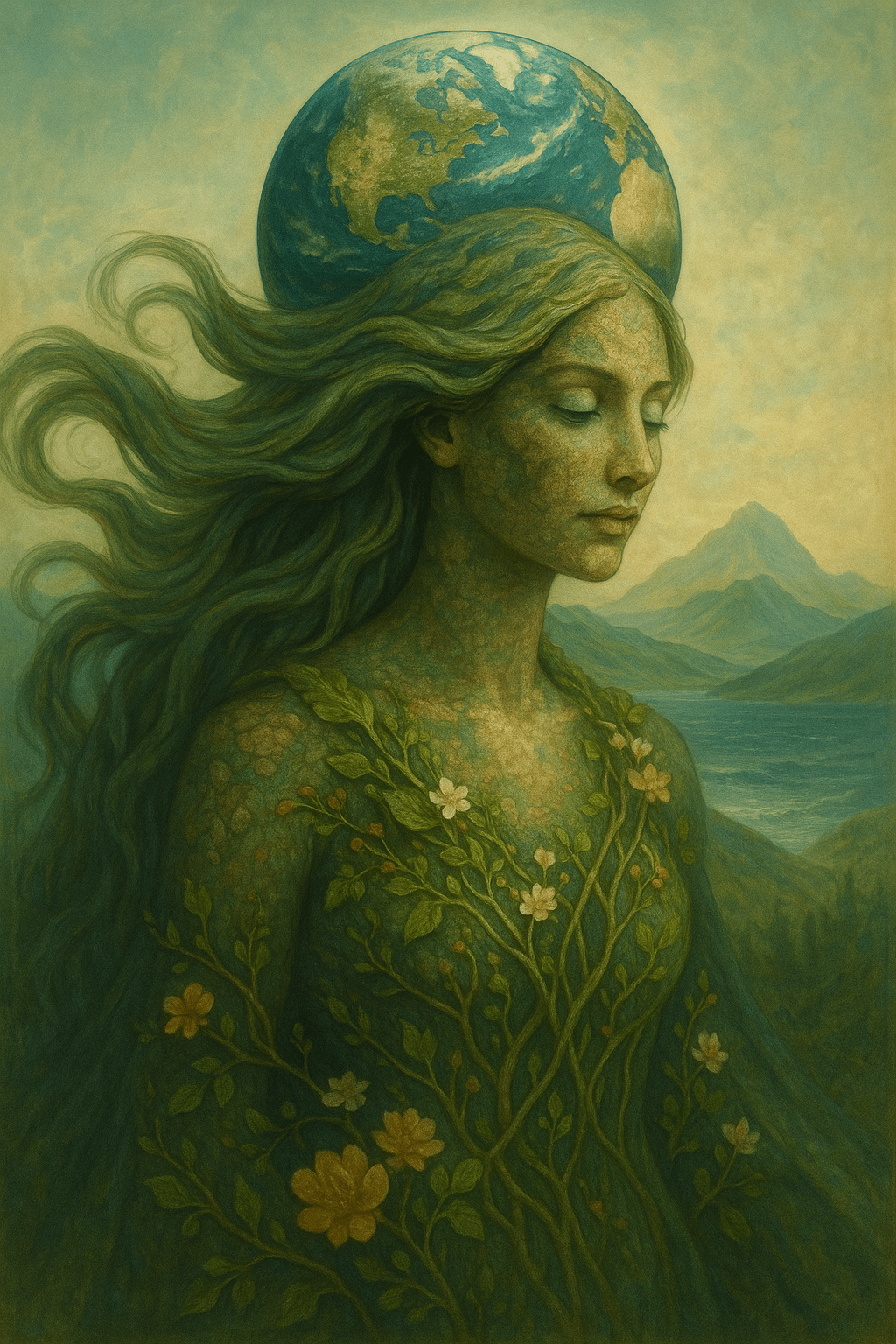
The Great Mother, or “goddess-mother-creator,” as Joseph Campbell calls her, is not to be confused with the archetype of the divine mother as we understand her in the person of the Virgin Mary. The Great Mother is both an origin point and metaphorical womb that encloses the world. In Classical myth, she appears as Artemis, Aphrodite, Demeter, Perspephone, Athena, etc. In Egypt, she is Isis. In Sumer, Inanna. Tara of the Buddhist pantheon also fits this description, as does Shakti of the Hindu tradition. The total goddess has a broad range of qualities and cultural associations. She is at once natural and supernatural, cosmic and specialized, and is imbued with various powers of nature. In her many guises, she embodies those powers in the physical world.
It is the lesson of embodiment that I’d like to talk about briefly here. To my mind, this is one of the greatest lessons the goddess has to teach us, and I think it is more relevant today than perhaps it has ever been. Be embodied. Here’s what Campbell has to say about it:
“Your body is her body.” Treat it that way. Care for it. Use it. Engage all of its wonderful capacities to interact with and make meaning in the physical world. I don’t think it’s enough to suggest that we are embodied spirit. I think that when we are fully integrated, or operating from the higher Self, there is no distinction between body and spirit. We are one. We are one with ourselves and with the earth from which we are made—the goddess herself. And the body is an expression of the spirit is an expression of the body in thought, word, and action.
When we fail to be embodied, we widen the chasm between the ego and the Self. When we rely on technology and other conveniences to the extent that we fail to develop or utilize basic skills, we run the risk of having technology become something like a defense mechanism, which Rollo May suggests makes us “uncertain in the impulses of the spirit.” It is through embodiment that we grow psychologically and spiritually. But that growth is also a figurative return: it is through acts of embodiment that we return to the Great Mother, to the womb from which we all came.
“When you go out into space, what you’re carrying is your body, and if your body hasn’t been transformed, space won’t transform it for you.” This is my favorite line from the preceding video clip. How often we take the metaphors of myth literally and look to forces outside ourselves to change that which is within. The Great Mother is a metaphor for transcendence. Transcendence of ego. Transcendence of the divisions between mind, body, and spirit. The earth-as-womb of the Great Mother is a metaphor for healing, integration, and rebirth, and it teaches us there is no realization of our higher nature without embodiment. Even the farthest reaches of outer space won’t bring us back to the Mother to whom we must return in order to find ourselves.


 The Used Life
Leave a comment