[Creative myth-making] restores to existence the quality of adventure, at once shattering and reintegrating the fixed, already known, in the sacrificial creative fire of the becoming thing that is nothing at all but life, not as it will be or should be, as it was or as it never will be, but as it is, in depth, in process, here and now, inside and out. – Joseph Campbell (quoted in Joanna Gardner’s The Practice of Enchantment)
Self-fashioning (a method for relating to the feminine archetypes) is a form of creative myth-making. In Joseph Campbell’s words, it is about “shattering and reintegrating the fixed, already known” and giving it new form, new life, in the here and now. Through the use of narrative and image, self-fashioning encourages women to use their creativity to reinvent the feminine archetypes in a way that is personally meaningful and that gives form and structure to their inner experiences. (This is something I came up with on my own, and I’ve found it extremely rewarding. If you are interested in doing one of these writing exercises, you can learn how here.) The idea that we can reformulate the feminine archetypes by giving them unique faces, names, attributes, and even personality characteristics based on our own experience is not only deeply rooted in Jungian psychology, it is also based on the mythological concept of the total goddess, as well as Campbell’s work on goddess mythology.
The total goddess is both a muse and architect for the “poetic realization of the self” (Cambpell’s words). And one of her singularly most creative acts is to take the naked energy of the eternal sphere and clothe it in the forms of this world (hence the term, “self-fashioning”). She is not only the generative source from which the feminine archetypes manifest in the field of time and space, but she is also the Self, or the whole which contains them all. As an embodiment of the cycles of life-death-rebirth, she teaches us that the path to integration for women should be poetic, dynamic, and rooted in wholeness, not hierarchies. That is to say that one feminine archetype does not have primacy over the others, but that individuation comes from realizing the eternal energies embodied by every woman in unique combination. To my mind, this dynamic is best represented pictorially as the seed of life and best encapsulated in the phrase, “The Self is the seed that germinates all others.”

If you’ve been following this blog for awhile and found the preceding (re)introduction to self-fashioning repetitive, my apologies. It’s been some time since I’ve written about it, and I felt a refresher would be nice. That said, I’ve been enjoying writing a self-fashioning narrative to coincide with each season. For me, these narratives serve the dual purpose of helping me feel connected to the seasons, as well as making the seasons feel more enchanting.
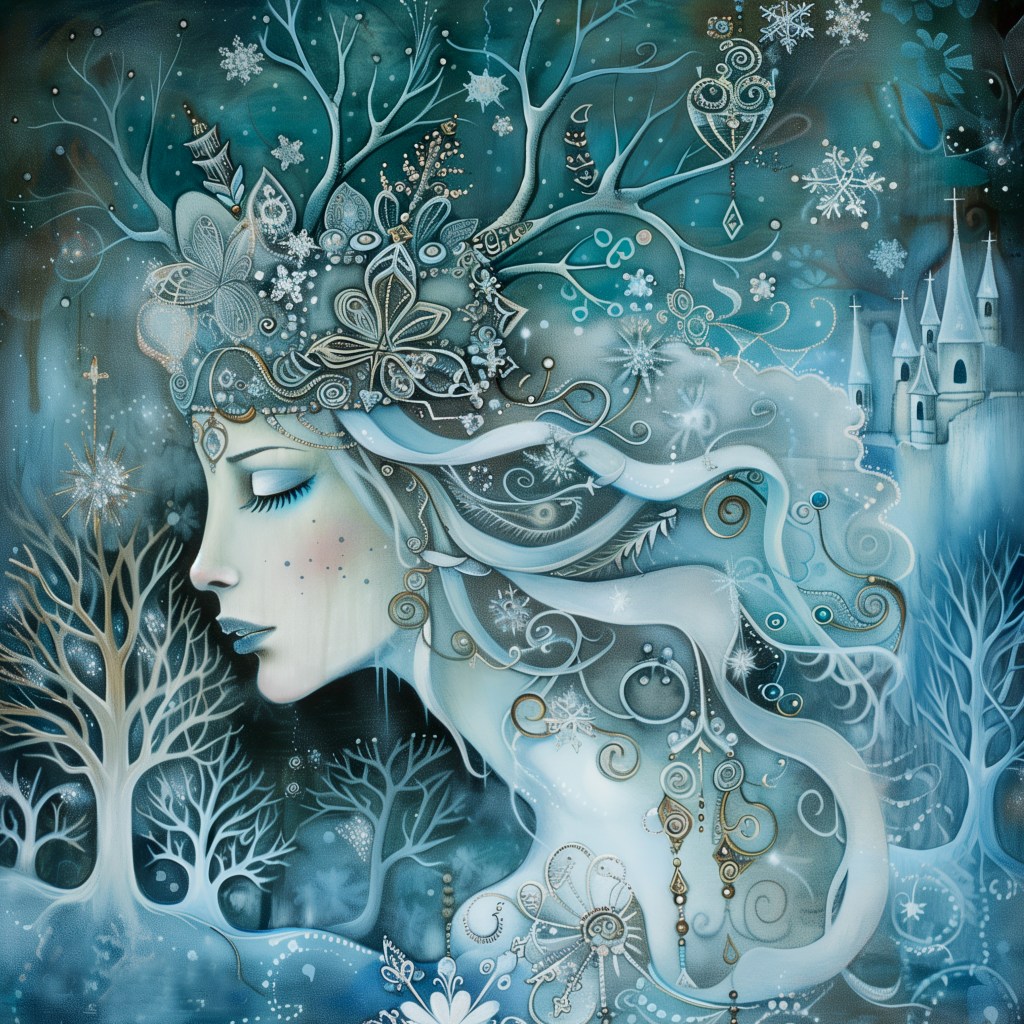
Winter, to my mind, is the most elegant of seasons and conjures something of a queen-like energy. But rather than calling the woman of winter a “Snow Queen” or some variation thereof (which would be fitting), I decided to choose a more personally meaningful name: “Woman of the Bare Trees”.
Where does that name come from? There is a patch of woods behind my home, which I can see clearly from my kitchen window. When I’m making coffee in the morning, usually around 6:45 a.m. or so, the very first hints of daylight are just becoming perceptible. And I love to look out at the trees, oaks especially, and watch their bare limbs reaching silently towards the sky. They almost look frozen in time. I am continually struck by the beauty and enduring elegance of that scene, similar to that of glittering snow- or ice-covered branches (which we rarely see here in North Carolina), but which also speak of nature’s ability to dazzle us even in the slowest, quietest, sparsest of seasons.
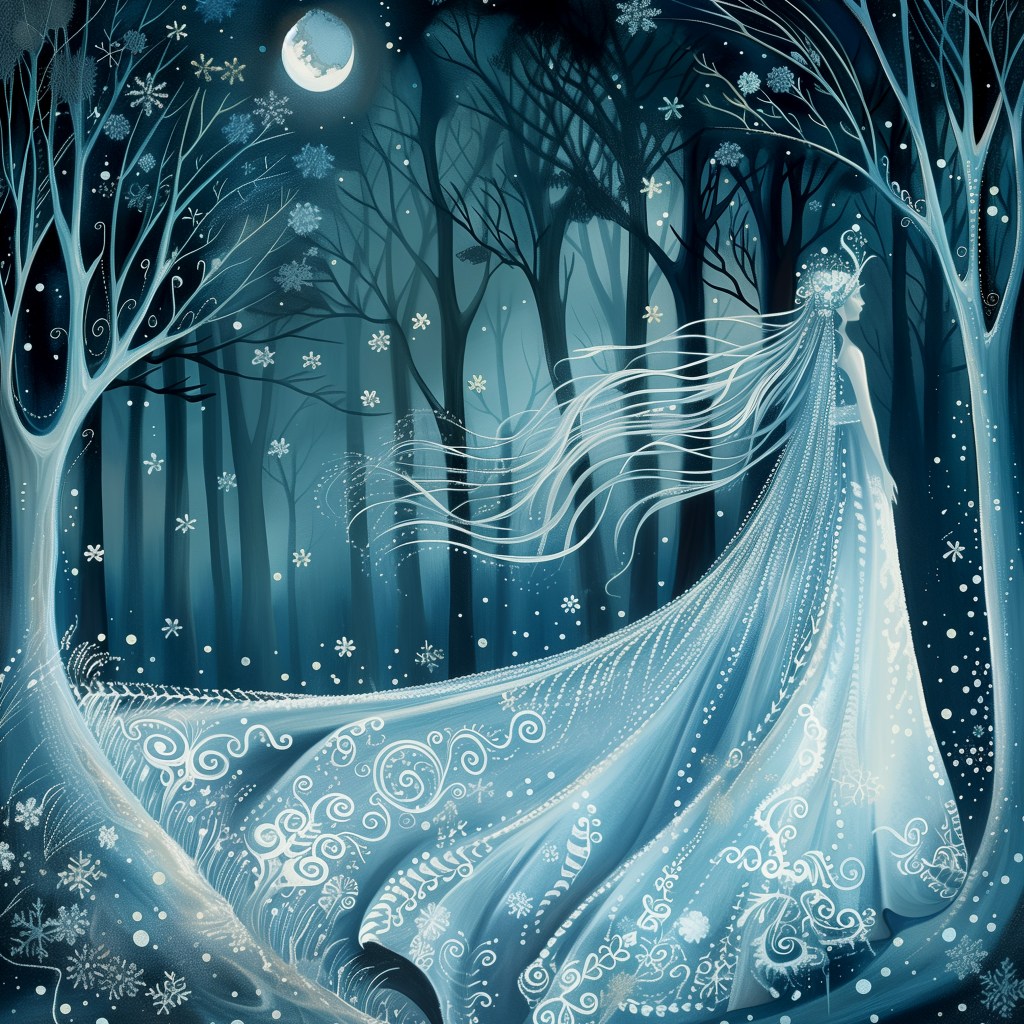
The Woman of the Bare Trees symbolizes ease, elegance, quiet strength, and endurance. She is in tune with her own rhythms, cycles, and seasons, and chooses to move with, rather than against, them. She embraces slowness, stillness, and regeneration in their time. She also knows that there are both wisdom and strength in honoring the needs of body and soul, as well as nature’s own seasons, rather than forcing ourselves to conform to others’ expectations or outmoded ways of being.
The Woman of the Bare trees is regal, graceful, and says little, but retains an aura of inner strength and power. Indeed, she knows better than to equate loud, aggressive, attention-seeking behavior with strength. She knows that confidence doesn’t have to announce itself. She navigates difficult terrain with courage, determination, and self-belief.
She is also wise enough not to rush the seasons—nature’s or her own. Indeed, if we are paying attention, there is a treasure (though sometimes hidden) to be found in each and every season of our lives. She continually reminds me to find the treasure in my life and embrace it, rather than spending my time wanting or wishing for something I don’t have.
The Woman of the Bare Trees knows how to embrace winter’s beauty and slowness through creativity, ritual and storytelling. She is a spirit of harmony in my life. She reminds me that I don’t need to be productive all the time, that I don’t constantly need to be busying myself or pursuing a goal. She is the embodiment of the beauty and grace found in stillness, the power of silence, and the magic that can be found in the simple, quiet rituals of everyday living.


 The Used Life
Leave a comment