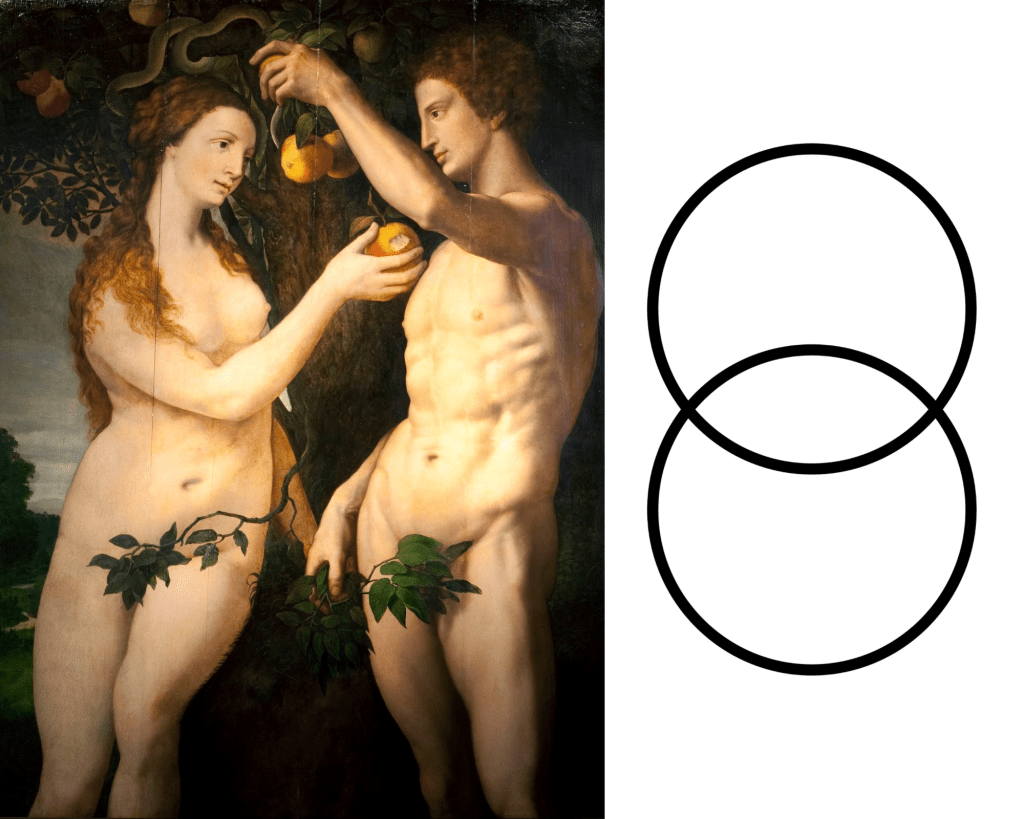
Frans Floris, The Fall of Man, public domain, Wikimedia Commons
The traces of geometry are expressed in the world so that geometry is, so to speak, a kind of archetype of the world.
I especially love analogies, my most faithful masters, acquainted with all the secrets of nature… One should make great use of them.
– Johannes Kepler
Carl Jung believed that the series of forms commonly referred to as “sacred geometry” have archetypal significance. The mandala, the tree of life, even circles, squares, and triangles are primordial forms that are rooted in the collective unconscious and, like other archetypes (e.g., the magician, the trickster, the wise old woman) have deep, analogical significance. That is, they point towards the existence of an unus mundus, or state of original oneness, in which nature and consciousness are reflections of one another.
Indeed, those forms which are present in nature as sunflowers, seashells, and snowflakes also give form to our experience—which is why we find them in religion, art, and architecture, historical and contemporary. We may call these geometric forms “forms of the soul”.
Of these forms, mandalas were of particular importance to Jung. He saw the mandala as representing both the archetype of the Self and the hero’s journey that leads to integration and self-realization. As Jung noted, forms of the soul can be used for healing and integration. They also give us valuable insight into how we are made.
I’ve mentioned previously that I thought it might be fun to use these forms in conjunction with stories from mythology, folklore, or fairytale, as well as the visual arts, to talk about the nature of the “psyche,” as it’s referred to in depth psychology. This is what Jung did when he talked about the Self and the hero’s journey in terms of the mandala. It’s also something like what I did (and intend to do again, only more in-depth) when I talked about goddess consciousness, or the feminine archetypes, in terms of the seed of life. Using forms from sacred geometry in textual analysis as analogies for the various structures and processes of the psyche can be both illuminating and prescriptive.
And that’s what I would like to do (or attempt to do) for the rest of this post. I’d like to talk about the story of Adam and Eve, or The Fall of Man, in terms of both the birth of ego and of the ancient geometric symbol, vesica piscis (pictured above), which I think represents the underlying “form of the soul”.
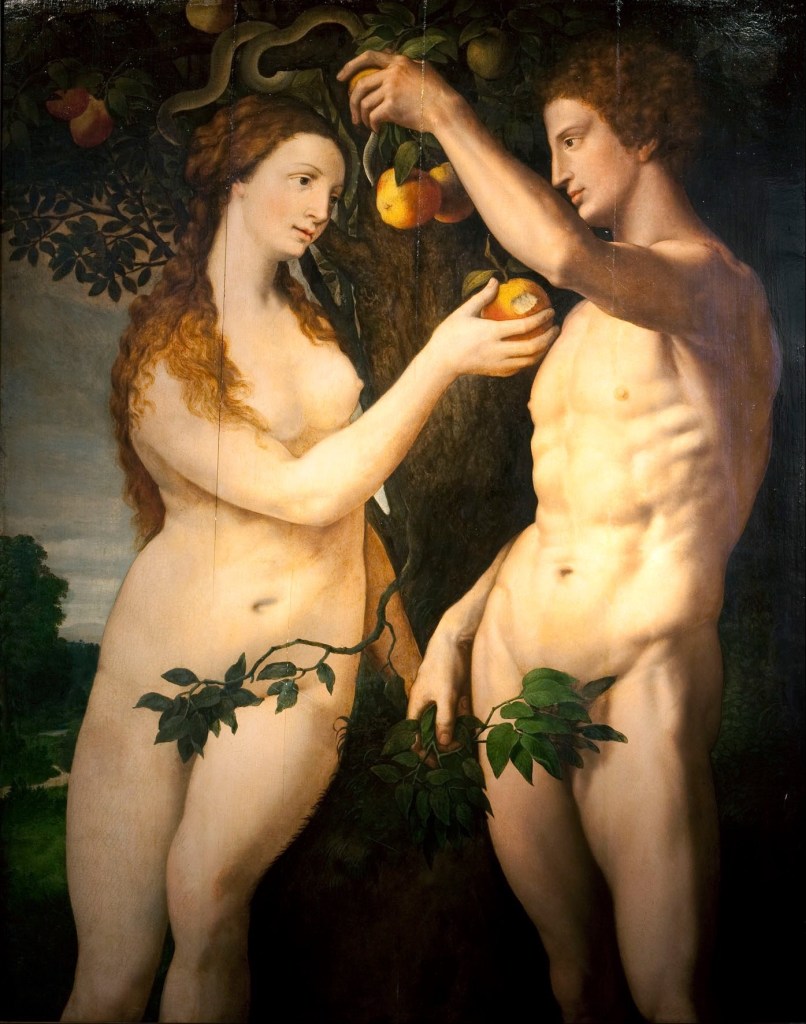
To my mind, The Fall of Man is best read as a story about the birth of the ego. To eat the fruit of the tree of knowledge is to become indoctrinated in the ways of the world, which results in self-consciousness and a subsequent loss of innocence. It is self-consciousness, or ego, which gives rise to shame, toil, and suffering.
The most impactful moment in this story, for me, is the moment when, upon eating fruit from the tree of knowledge, “the eyes of both of them were opened, and they realized they were naked; so they sewed fig leaves together and made coverings for themselves” (Genesis 3:7). The ego is born when their eyes are opened. The recognition of nakedness is evidence that a split has occurred in the psyche: Adam and Eve are suddenly witnessing themselves and the world from another vantage point, the damage from which is irreversible, as God says, “By the sweat of your brow you will eat your food until you return to the ground, since from it you were taken; for dust you are and to dust you will return” (Genesis 3:19).
Where previously Adam and Eve were in full alignment with their divine inheritance, they are now in possession of a higher and lower nature, having been lured away from the sacred by the mundane.
Implicit in this story is the understanding of something like an original psychological wholeness, which is subsequently divided. This process, to my mind, is best represented pictorially as the vesica piscis, a symbol that has historically been associated with balance and the union of opposites (e.g., masculine and feminine, sacred and mundane), the central oval often equated with creation, openness, revelation, or the feminine principle, more generally.
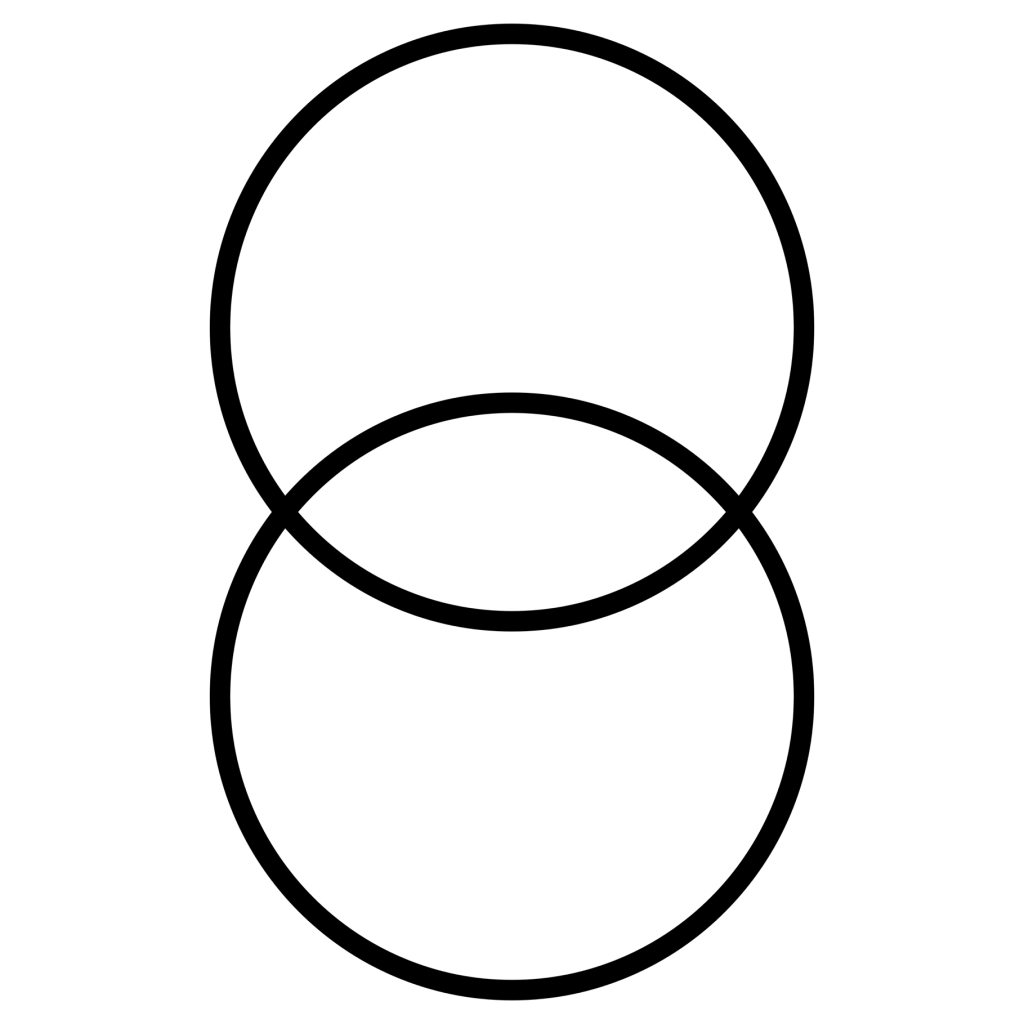
The vesica piscis is at once a symbol of union and separation and is, to my mind, characterized by a tension of opposites: two forms that are simultaneously being drawn together and repelled in equal measure, which is what prevents the two circles from fully overlapping.
We see this same tension in some of the most iconic artistic representations of The Fall: namely, those depicting Adam and Eve on either side of the tree of knowledge.
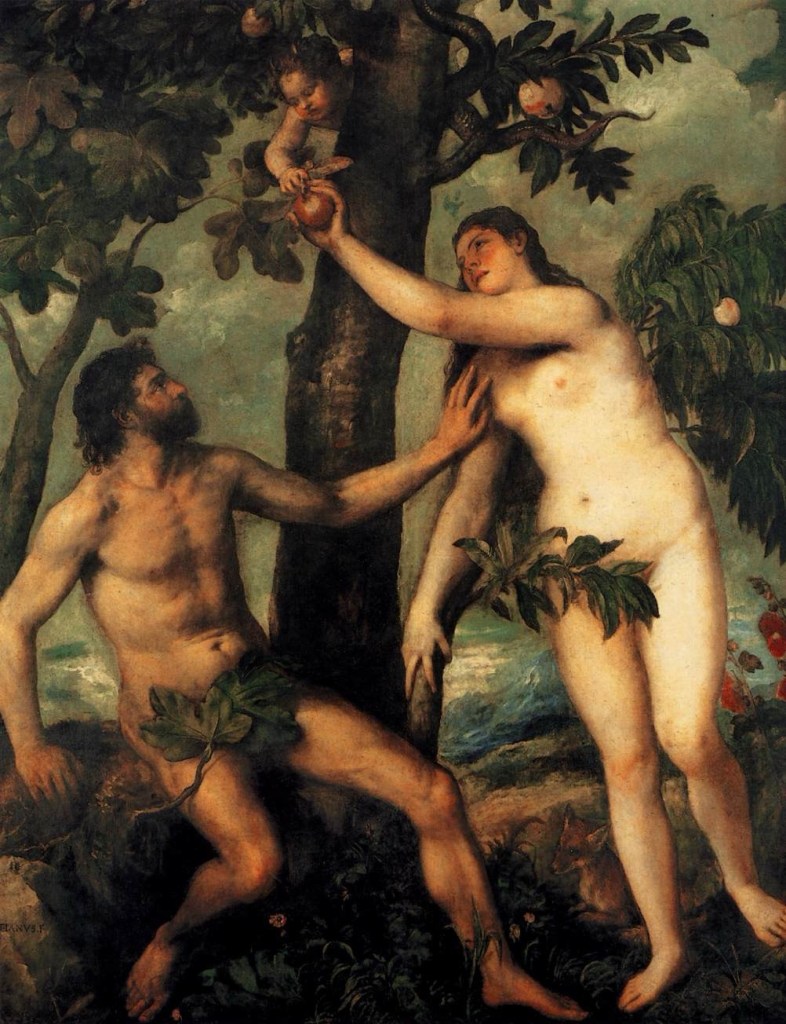
To my mind, the tree, as well as the serpent, are the primary sources of tension, something like a central point or dividing line that prevents the union of opposites, which here occurs on multiple levels: masculine and feminine, earthly and spiritual, as well as the higher (good) and lower (evil) aspects of human nature. While story of The Fall contains obvious correlations between femininity and weakness, which makes Eve more prone to temptation than her counterpart, I don’t think it would be wise to equate Eve with the lower aspects of human nature.
I rather think both Adam and Eve—taken individually or together—represent a state of wholeness, or what might be considered a divine inheritance, and it is the birth of self-consciousness (we are reminded by the fig leaves) that creates a psychological split, opening the door to a lower nature in the form of repressions. This split also transforms their relationship into one that is at least partially characterized by suffering, rather than the complete and harmonious union of opposites: “I will make your pains in childbearing very severe; with painful labor you will give birth to children.” (Genesis 3:16). It is possible, too, to see Eve as being pulled first out of the sphere of original wholeness, with Adam soon to follow.
This same dynamic is illustrated by Jung’s diagram of the psyche. One cannot help but note the strong visual similarities to the vesica piscis.
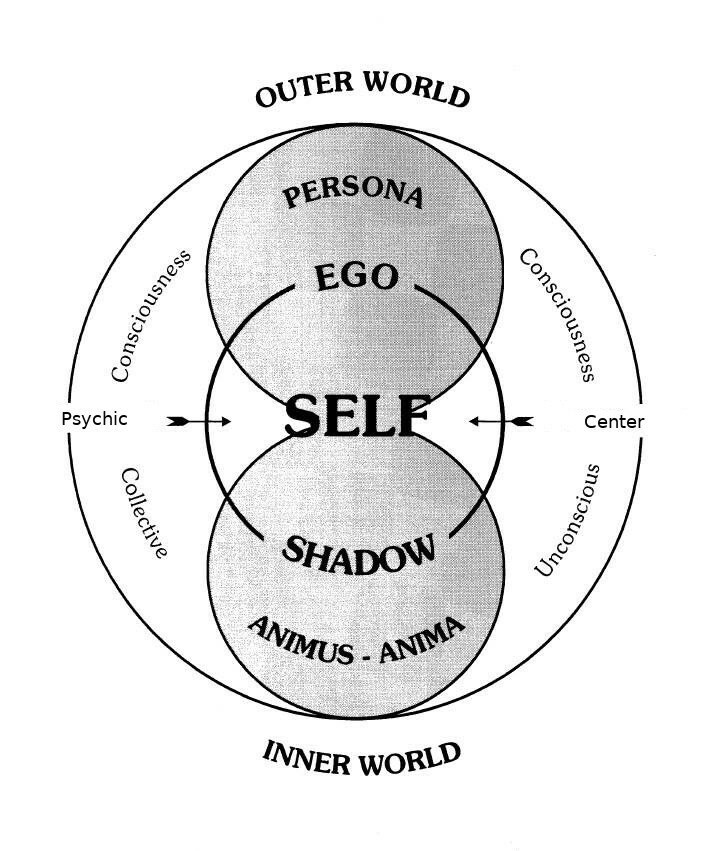
What’s noteworthy here: the archetype of the Self occupies the central point, or center of overlap, which is in keeping with his theory of integration. As more and more of the shadow becomes conscious, more and more of the lower circle becomes subsumed by the higher, and the size of the Self grows, such that the tension of opposites—here, exacted through the work of defense mechanisms which keep our repressions from becoming conscious—resolves. The Self then appears as a single, uninterrupted circle, which for Jung was an emblem of psychological wholeness.
It’s worth noting that we see some conceptual similarities in Freud’s topographical model of the mind.
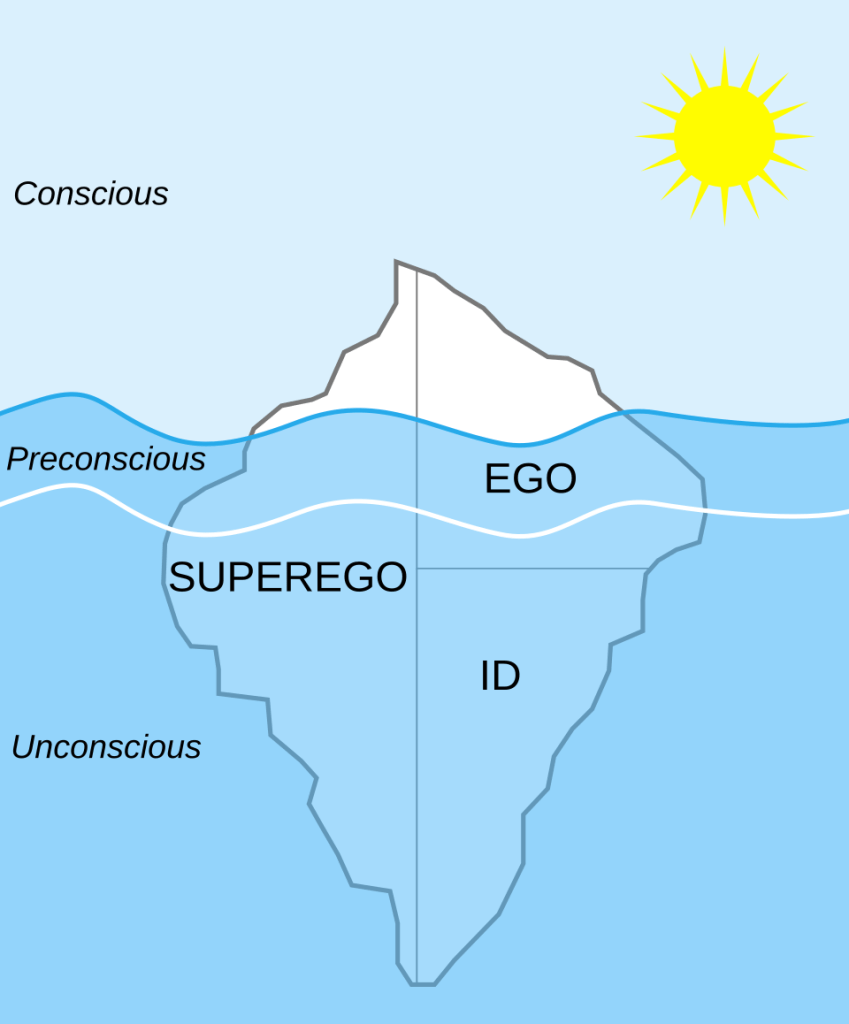
While Freud didn’t postulate the existence of a “higher self,” he did believe the mind was characterized by a constant state of conflict or tension between id, ego, and superego, with the unconscious exerting the greatest influence, or gravitational pull. For Freud, the more unconscious, or repressed, material was made conscious, the more suffering was alleviated and balance restored to the individual.


 The Used Life


Leave a comment