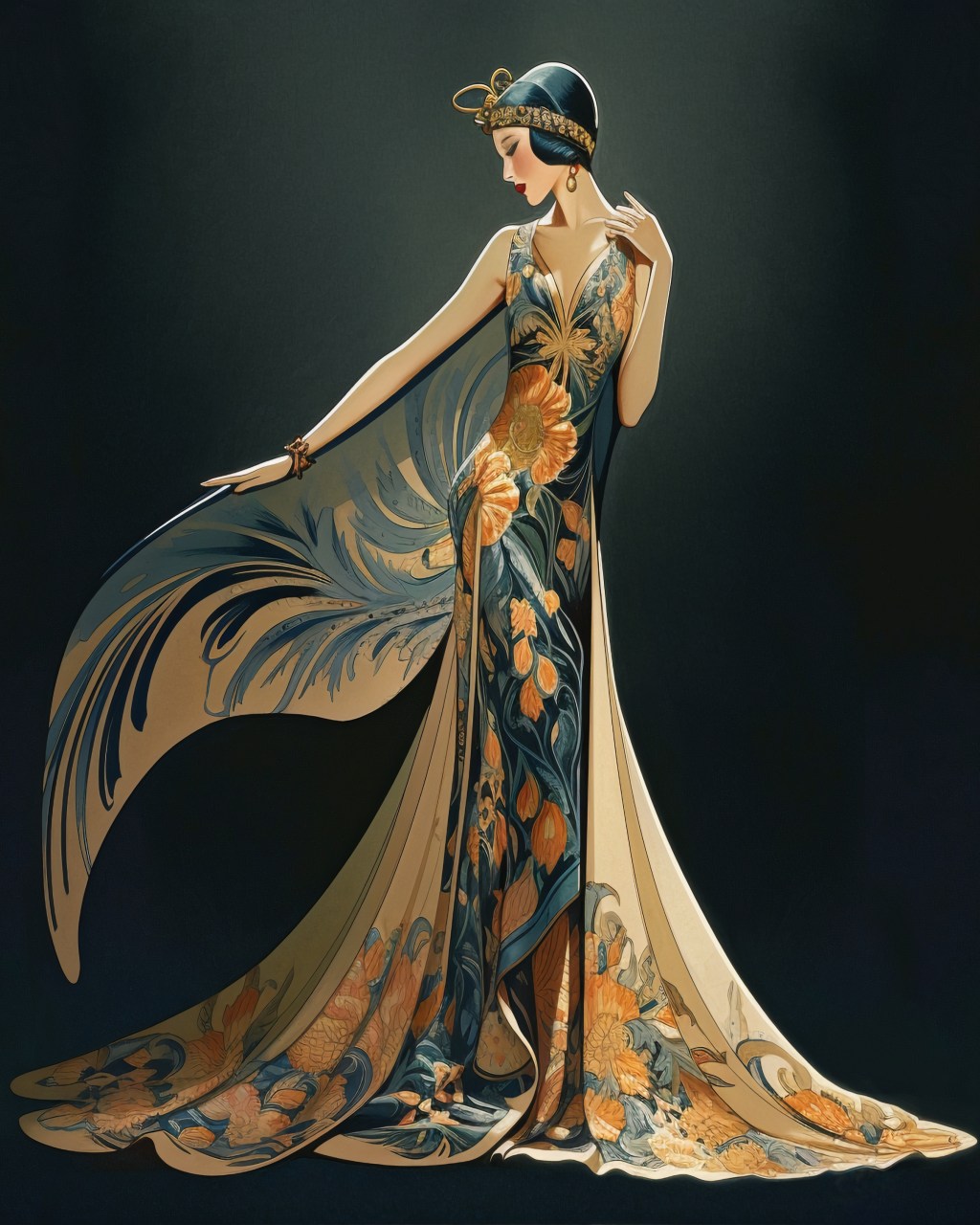
Artwork by Elowen Digital
I take pleasure in my transformations. I look quiet and consistent, but few know how many women there are in me. – Anaïs Nin
I wrote my first self-fashioning narrative, “On the Art of Femininity,” in 2017 without even quite realizing what I was doing. At the time, I was just starting The Used Life, which was (and still is) aimed at exploring my interests and actualizing my talents. And I have always had a love for psychology; so that seemed the perfect place to start. I also have a keen interest in the nature of femininity, and at the time I recall being dissatisfied not only with popular conceptions and portrayals of the feminine, but also with methods aimed at understanding the feminine psyche in terms of traditional archetypes.
It is the artist in me that loves (perhaps a little too much) destroying old forms and creating new ones. And my relationship with the feminine archetypes, as with mythology, generally, tends to be characterized by that same impulse. The problem, for me, is first and foremost one of translation. When I try to understand my inner experiences in terms of a construct like, say, the queen or the witch or the wise woman, Artemis or the Virgin Mary, something gets lost. It’s as if I’ve taken the familiar and made it unfamiliar, taken an experience that is deeply personal and meaningful and somehow made it less so. That is, the traditional vessel, or container, feels ill-fitting for the contents.
The solution, for me, is to reinvent the eternal feminine as I experience it, either by giving a new name, a fresh face, and an updated vision to an existing archetype or by creating something new entirely—something that represents a blending of forms—but that is personally meaningful and that reflects my individual preferences for storytelling. In place of certain aspects of the witch, for example, I have The Dragonslayer. In place of the mystic, I have the Natural Healer. In place of the maiden, I have the Woman of the Flowers. In place of the Self, I have The Whole Woman. But, I have also given form to an inner Alchemist, a Free Spirit, a Spiritual Healer, and a construct that is near and dear to my heart that I like to call The Gardener—and I’m not done yet. And, finally, there are some archetypal experiences that I think are best described in terms of the way they make me feel, like feeling pretty, feeling sexy, or wanting to be wanted. I am happy to explore these feelings and desires on their own terms.
It is this exercise in creative myth-making that I call “self-fashioning.” From the beginning, my intuition told me I was on to something—that this idea had merit and that self-fashioning was something that could help other women understand themselves. The deeper I delved into my idea, or rather, the theory behind it, the more I started to feel there was a real disconnect between the Jungian model of individuation and what I was doing with self-fashioning, or what I was sensing about the nature of the eternal feminine. Every time I looked at Jung’s model, based on the hero’s journey and represented pictorially by the mandala, a little voice in the back of my mind insisted, “This isn’t quite right. This isn’t what this looks like.” But, I had a lot of learning to do in terms of both mythology and Jungian theory before I could articulate my vision adequately. I wasn’t able to make the strides I wanted with my ideas right away, so I put them on the proverbial back burner and didn’t pick them up again until early 2025. And that was when I experienced the breakthroughs I needed.
Those breakthroughs surround goddess mythology (and a crash course I gave myself on the subject courtesy, mainly, of the writings and lectures of Joseph Campbell) and what those stories tell us about the goddess as psychological construct: what she represents, how she operates, the “logic,” if you will, behind goddess consciousness. To decode the goddess is to decode the eternal feminine, and that was what I set out to do. Here’s a brief summary:
In mythology, the great goddess, or total goddess (“total” because she is multiple, often occupying many forms at once), is both eternal muse and architect for the “poetic realization of the self” (Cambpell’s words). Her most significant creative act, as mother of the spheres, is to take the naked energy of the eternal sphere and clothe it in the forms of the material world (hence the term, “self-fashioning”), a dynamic which is illustrated in the figure below from the Practica Musicae of Franchinus Gafuruis depicting stages in the illumination of the human soul.
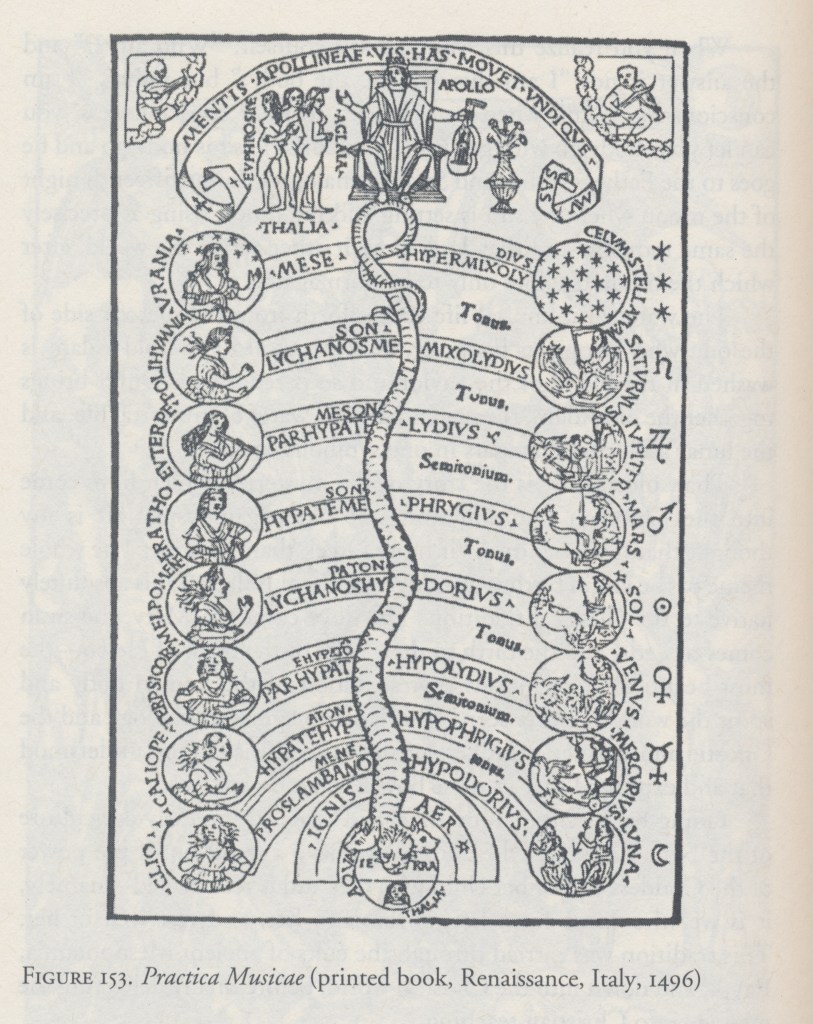
The banner at the top reads, “The energy of the Apollonian mind moves everywhere through the muses.” The muses are inspired by the naked or raw cosmic energy of the graces (pictured to the left of Apollo), which are extensions of the goddess, Aphrodite. The muses are that raw energy in embodied form, “clothed in the forms of the world”. Per Campbell’s analysis, “In the field of time, the mystery is clothed, while in the eternal sphere it is unclothed.”
Campbell here likens the relationship between Apollo and Aphrodite to that between Shiva and Shakti (or śakti) in Hindu mythology. Shakti is a total goddess and the embodiment of cosmic energy, of the universal forces that sustain all existence. Like other goddesses, she has many manifestations and is otherwise unknowable without them. Self-fashioning mimics this process of distilling spiritual energy into material form, or of making the eternal, universal, and impersonal personal (clothed in the forms of the individual psyche) because this is the way of the goddess.
The goddess is not only the generative force from which archetypal forms manifest in the field of time and space, but she is also the Self, or the whole which contains them all. As an embodiment of the cycles of life-death-rebirth, she teaches us that the path to integration for women should be poetic, dynamic, and rooted in wholeness, not hierarchies. That is to say that one feminine archetype does not have primacy over the others, but individuation comes from realizing the eternal energies embodied by every woman in unique combination.

To my mind, this dynamic is best represented pictorially as the seed of life (as opposed to the mandala used in Jung’s model), as well as summed up in the metaphor: the self is the seed that germinates all others.
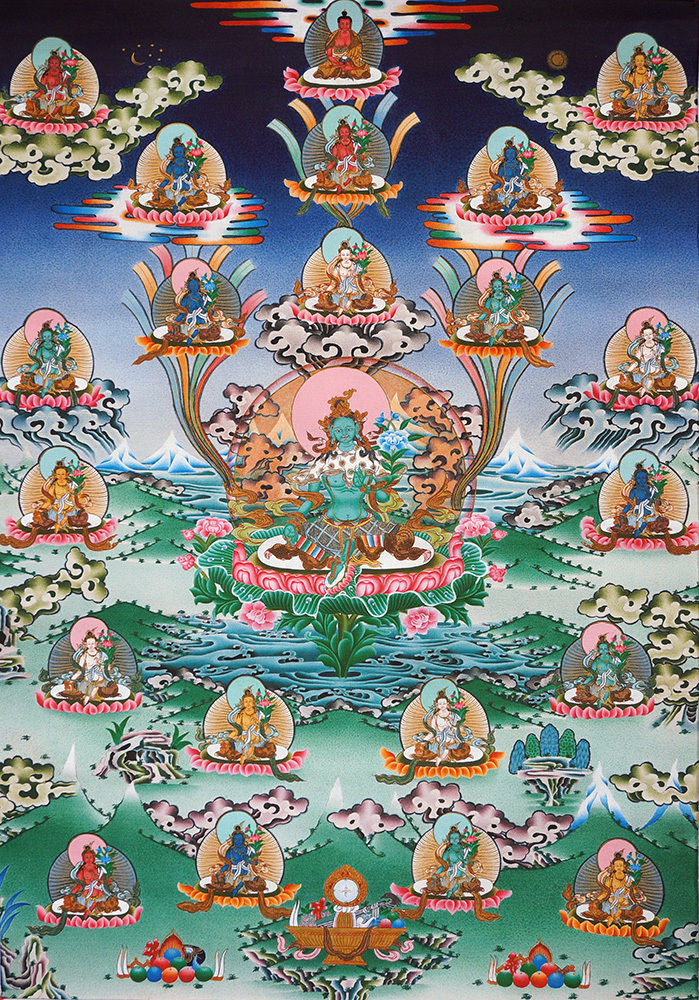
The Self, or individuated woman, then, is a whole that is indistinguishable from her parts. She is not the virgin mother, nor is she the witch or the queen or the wise woman. The Whole Woman, as I like to call her, is found in the interstices. She is each of these in dynamic relation to the others. And her realization can, and should, be unique to every individual. The inherent creativity of the feminine, as well as the uniqueness of every woman and the goddess’s prerogative to continually reinvent herself or to simultaneously occupy a variety of forms, as Tara from the Buddhist pantheon, are central to the idea of self-fashioning.
I am very much motivated by a belief that we, as women, deserve our own origin story and our own symbols, as well as our own model and method for understanding ourselves. Self-fashioning is about “shattering and reintegrating the fixed, already known” (Campbell’s words) and giving it new form, new life, in the here and now. The objective is not to become goddesses ourselves but to re-invent the goddess in our own likeness. That is, self-fashioning is less about universalizing our experience and more about humanizing the myth. It’s about understanding the inner feminine as a translation of the divine and acknowledging that the goddess already lives within us and always has. She’s just waiting for us to discover her.
This comprehensive re-introduction was a long time coming. Thank you for hanging in there and being patient with me! I am now deleting several previous posts on the subject, like “On-Self Fashioning,” “Total Goddess: A Gateway to Consciousness,” and “The Play Principle” because they are outdated and/or no longer applicable.


 The Used Life
Leave a comment