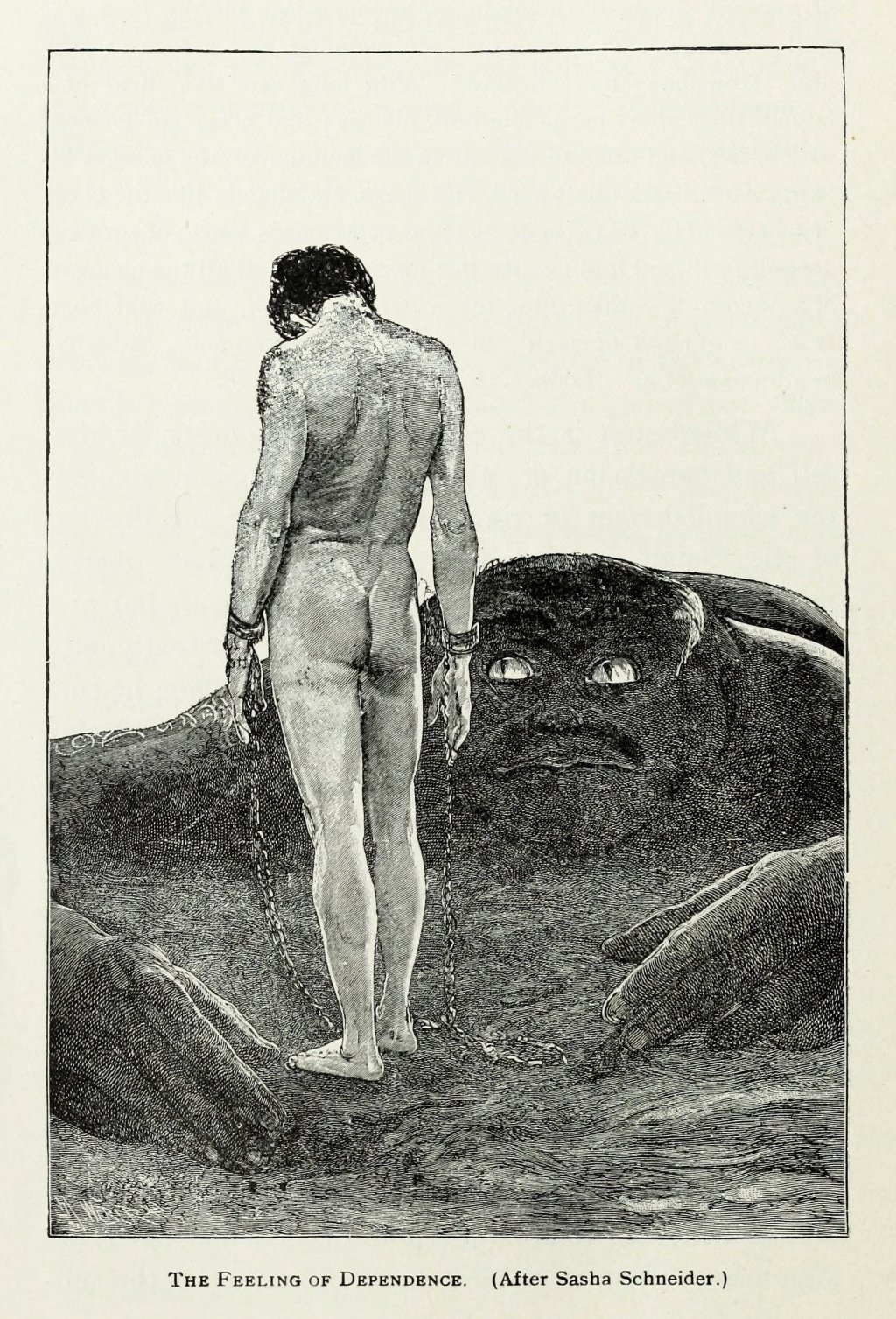
The Feeling of Dependence, Sasha Schneider, 1899. Image sourced from the Public Domain Image Archive / Internet Archive / California Digital Library
If one is to love oneself one must behave in ways that one can admire. – Irvin D. Yalom
The early hours of the morning (from 5 or 5:30 a.m. until sunrise) are my favorite of the day. I enjoy sitting with my coffee and journaling, brainstorming creative ideas, or curling up with a good book. This morning, I chose to sit with a book. I am currently reading Agatha Christie’s Hallowe’en Party, and I am at that point in the novel at which I need to know whodunnit. So, I poured my coffee, turned on my reading light, opened my book, and rather than settling into the story, I found my thoughts moving in a decidedly spiritual, even religious, direction…which is unusual.
Nevertheless, I feel these thoughts may be worth sharing; so, here is what came to mind. Please don’t interpret what follows as a lecture, or as me preaching to you in some way (I am in no position to preach to anyone.). Think of it instead as me speaking to my younger self. If I could go back in time and talk to 20-something me, this is what I would tell her:
If you are engaging in behaviors that make you feel badly about yourself, knock it off. I say that lovingly and with respect. It doesn’t matter who’s promoting that behavior—whether it’s a friend, family member, celebrity, or other public figure. You know a behavior is bad for you by the way it makes you feel. Sometimes those feelings are easy to identify, like remorse, regret, and shame, but sometimes they’re more complex. Take cognitive dissonance, for example, which is more discreet and insidious. That’s when you find yourself making all kinds of excuses for your bad behavior because it doesn’t align with your values, what you know to be right, what you know to be true, or what you know to be good for you. But you’re not willing to abandon the behavior, even though it makes you suffer, because there are other rewards attached to it or because it serves another function in your life.
Indeed, some of us spend our entire lives making justifications for our bad behavior without ever addressing the behavior itself. This is both remarkable and tragic. Addressing the behavior is at once the most effective and most challenging course of action—challenging because it inevitably requires showing up for ourselves, or demonstrating a level of care for ourselves, to which we are unaccustomed. It is like a medicine we don’t want to take.
Now, I may not be a conventionally religious person, but I do believe that knowingly engaging in behaviors that are bad for us constitutes a sin against the self. (I also believe in God. I’m not certain I believe in The Devil; although, sometimes I really do wonder…) Whether or not you believe there’s a devil “out there”, as you mature and get to know yourself, you’ll discover there is, in fact, a devil within. And it’s the devil within that’s a saboteur, that will keep you stuck in a cycle of bad behavior, that will slowly but surely erode your self-respect and self-confidence, and that will have you spending your days feeling miserable and empty and looking for happiness in all the wrong places.
Carl Jung once said, “People will do anything, no matter how absurd, in order to avoid facing their own souls.” Was he right! Here’s the truth: real, healthy, ironclad self-respect is earned. If you want to be someone you can admire, you have to act like someone you can admire. There is no amount of self-care that can counteract the effects of bad behavior. No amount of mediation, or cooking healthy meals, or hot baths, or long walks in the woods. There is an entire industry built on the idea that self-care can offset wrong action. It can’t. If you’re going out on Saturday and engaging in behavior that is, for example, degrading to your body and for which you later feel remorse, then engaging in self-care on Sunday, you are avoiding facing your own soul. That is, you’ve opened the door to the devil (either the one “in here” or the one “out there,” depending on how you choose to look at it). And you are stuck in a cycle that is very, very difficult to break.
If you are a student of history or of human nature or both, you’ll realize there is a predictable pattern to the way the devil, in terms of both bad behaviors and bad ideas, shows up in our lives. And it’s usually slowly and insidiously and disguised as something new, fresh, and exciting, much in the way that “all that glitters is not gold.” Examples from history include the rise of Nazism and communism. And the pattern goes something like this: we’re introduced to new ideas that promise to alleviate our suffering and solve our problems. Some of us will invariably be enticed by these ideas. Others of us may reject them, or resist, because we sense they’re wrong. But as they are implemented, we adapt. Over time, we’re introduced to more and more of these same kinds of ideas. We may resist again, at least initially, but over time, we adapt further. Those who continue to resist are silenced. The majority of ordinary people adapt. Until one day, we realize the door we once opened ever so slightly to the devil has been blown off its hinges, either because we did the deed ourselves or because we sat back and did nothing. At that point, resistance is futile. That is to say, by the time we recognize the magnitude of what’s happened, it’s already too late.
A similar pattern repeats itself in our personal lives with regard to our habits and certain other behaviors. We are, indeed, remarkably adaptable creatures in both mind and body. We adapt to physical exercise. We adapt to dietary changes, good and bad. We adapt to substances, like drugs and alcohol. We adapt to all sorts of shifts in culture, technology, language, art, music, lifestyle, etc. For better or worse. Our ability to adapt to, or be conditioned by, our environment enables us to survive, but it’s also one of our greatest weaknesses. We adapt to bad ideas and bad behaviors just like we adapt to good ones. And once we adapt to something, once we’ve overcome our initial resistances (if we have any) and are no longer mindful of it, or once we have accepted a particular behavior as part of our “normal,” it has the ability to control us—not the other way around—and to wreak havoc on our lives.
My advice is simple: be someone you can respect. Carl Rogers said, “The curious paradox is that when I accept myself just as I am, then I can change.” He’s right. Accepting ourselves doesn’t mean thinking we’re perfect as we are. It means caring enough about ourselves to make the right changes, to do the right thing for ourselves. That, I’m pretty sure, is what that quote means. There is additional irony in the fact that, in order to reach that place of care and self-acceptance, we must first take right action. So, if you’re behaving badly, knock it off. And whatever you do, don’t let the devil walk in. Or you may spend the rest of your life trying to get him to leave.

