It perhaps goes without saying that there are certain archetypal influences, or trends, in our personalities that are more dominant than others. That emerge more frequently and that exert a more profound influence than others. One of those trends, for me, is that of the natural healer. “Natural healer” is my term based on my inner experience. You might think of her in terms of a priestess, wise woman, mystic, medicine woman, or wild woman. In fact, the brief description that follows is probably a blending of all of these figures, for those who consider them separate.
I think what I enjoy most about self-fashioning exercises like this one—and a big part of what makes them worthwhile—is that they allow for individual differences in storytelling and meaning-making. That is, in my mind or according to my inner experience, the above-mentioned archetypes sort of blend together. I don’t know that I could write a narrative of any real substance about an inner wise woman, priestess, or wild woman, and yet those influences are among the most dominant—if not the most dominant—in my personality (I believe) and always have been. But the natural healer—she is a unique blend of all of these things. And she is, without a doubt, my favorite of the feminine archetypes.
Also, I think it’s worth mentioning briefly, before getting into my short narrative about the natural healer, that I’ve begun thinking of the feminine archetypes and their relation to the Jungian concept of the Self very much in terms of a seed of life. Interestingly, the seed of life is a symbol that has been used in some cultures to represent the divine feminine, the cycles of creation, and fertility for centuries.

Jung thought of the Self, or of the process of individuation, in terms of a mandala. But, with regard to the feminine, I like the seed of life better. That’s because I don’t think there’s one overarching archetype, or Self, that emerges as a result of individuation for women…at least not in the same way it emerges for men. I rather think the feminine archetypes all come together to create a Whole Woman (Self) and that the Whole Woman is indistinguishable from her parts, as the overlapping circles in the seed of life. That’s really the basis of self-fashioning.
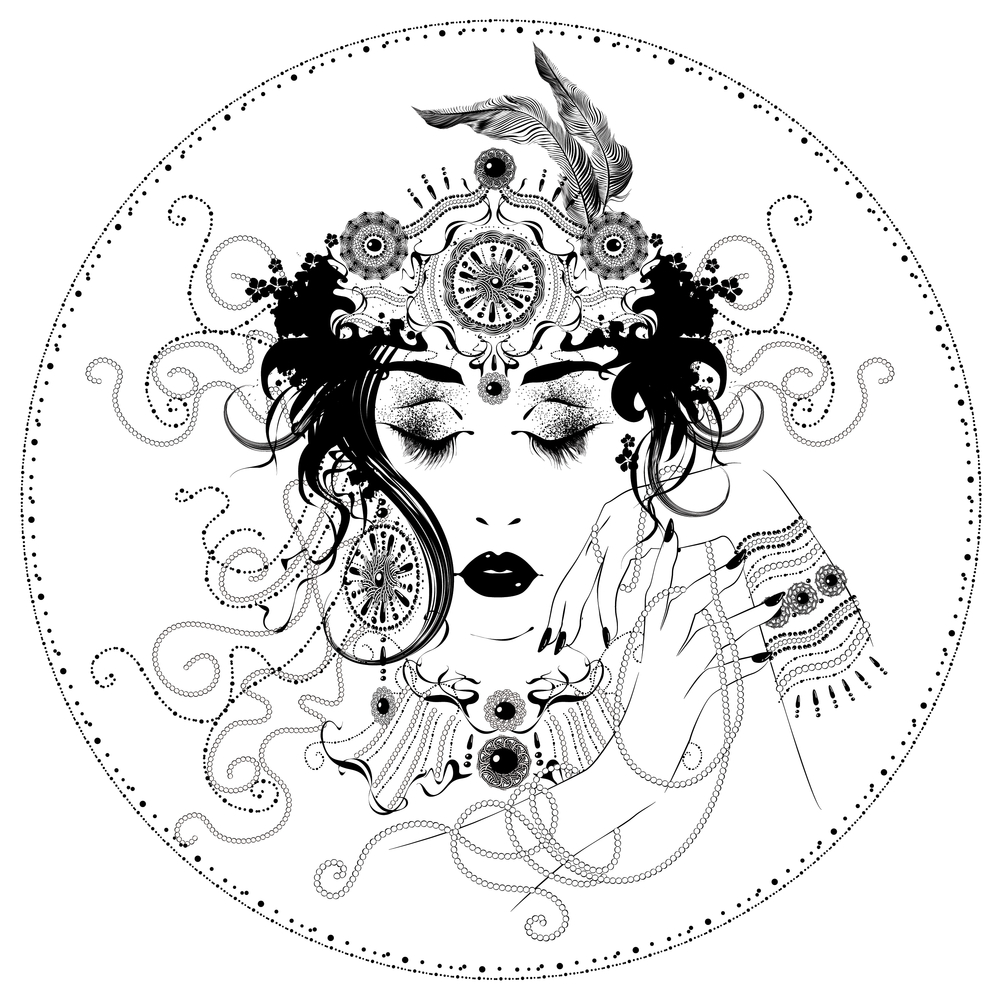
The natural healer calls me to return to nature. Her roots are deep. Her hair is wild. Her eyes are serene and untamed. She knows, perhaps, more than she should. She is receptive to wisdom in all of its forms. She knows how to listen to the silence and make it speak.
She is the great healing force inside of me. When I need to sit in nature and meditate, when I need to get lost in the forest, when I need to appreciate the beauty of a flower or a butterfly, she asks me to stop, to put down my work, and allow my spirit to rest.
The natural healer understands that stillness is fertile ground. That there is no self-knowledge, no wisdom, nor creativity if we are not receptive to stillness. She values solitude. She needs to feel the bare earth beneath her feet and the sun shine down upon her face.
For the natural healer, nature is both within and without. There is wilderness beneath her skin. She loves ritual, but she also knows that her senses, her body, her very being are what connect her to all of creation. Nature, in her eyes, is a manifestation of the great mystery, of God in all things.
The natural healer embraces her own cycles, her own seasons. They are sacred. To paraphrase Anaïs Nin, she is not afraid of her own depths, but she is afraid of shallow living.


 The Used Life
Leave a reply to theusedlife Cancel reply