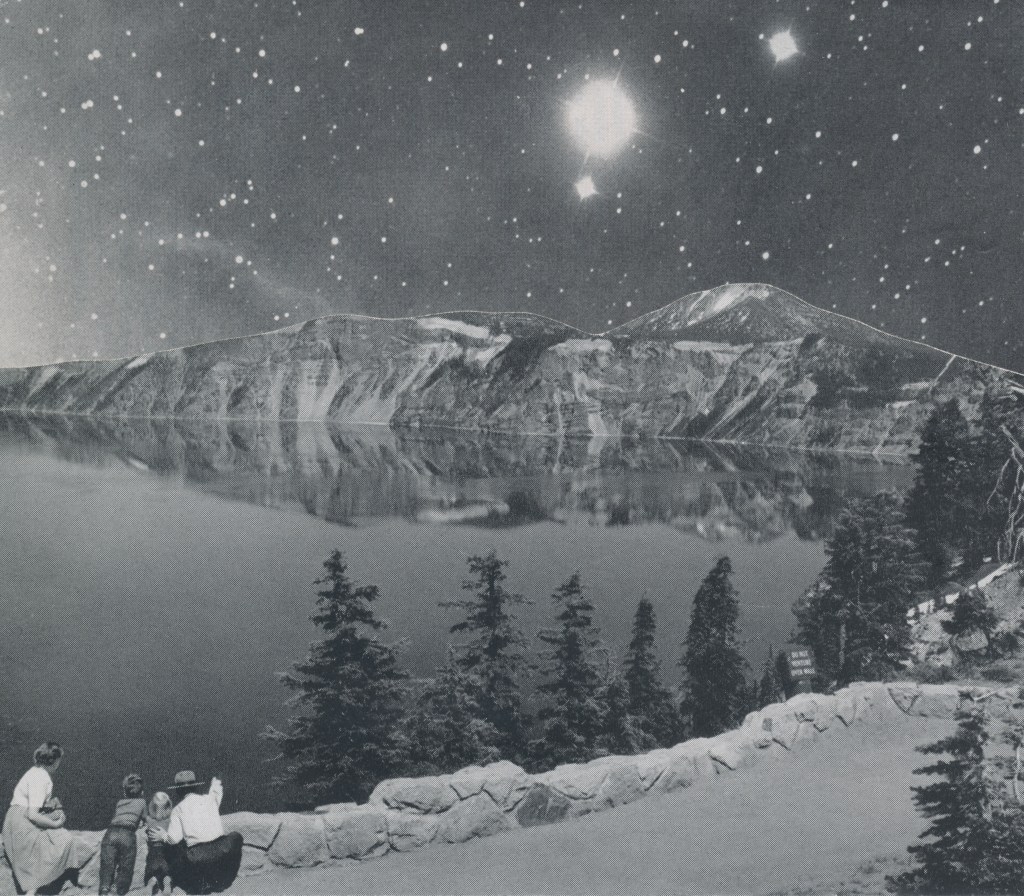
The Future Is a Distant Star, paper collage, 2025
Be attentive to the stirrings of your soul.
Learn how to do the things you love for their own sake. Because they give you joy, because they’re inherently meaningful and fill you with a sense of purpose. We’re not conditioned to behave this way. We’re conditioned to do the opposite: to pursue those activities that promise financial reward, power or prestige, to pursue the proverbial dangling carrot instead of learning the intrinsic value of developing our talents or pursuing a purpose-driven existence.
But the truth is, when we learn to do things for their own sake, we not only become exponentially more powerful, we become unstoppable. Our actions are no longer dependent on an external reward. It no longer matters if others approve of us, if we achieve recognition, success, or any sort of financial compensation. When we transcend the dichotomy between means and ends, we operate from a place of power and freedom. When I am doing what I was made to do simply because I was made to do it, there is nothing on earth that can stop me. There is no force powerful enough to hinder my motivation.
Maslow writes about this. He says that, at the higher levels of motivation, the things we do become ends in themselves. On one hand, this kind of activity appears purposeless—it emanates from the center of our being without being tied to any goal or reward other than itself. On the other hand, this kind of activity is probably the most purposeful of which we are capable, but that sense of purpose comes from within.
“Everything now comes of its own accord, pouring out, without will, effortlessly, purposelessly. He acts now totally and without deficiency…not to avoid pain or displeasure or death, not for the sake of a goal further on in the future, not for any end other than itself.” – A. H. Maslow
An important lesson I’ve learned over the years: don’t be someone who pursues the dangling carrot. It’s enough that life requires us to pursue external rewards in the name of making a living and achieving other practical ends. Don’t let that distort your attitude. Don’t be someone who refuses to act without the promise of a reward or who quits when the going gets tough. You’re better than that. If you love something, learn how to do it for its own sake. Become familiar with that feeling of intrinsic satisfaction. Allow it to be your guide and your anchor. That feeling is your soul saying “yes” to its passions and “yes” to life. Dangling carrots are little more than a cheap facsimile.
May your roots be wild and deep.
As far as I’m concerned, my job as a human being is to find what I love on this earth and make more of it. Whether that means writing poetry or feeding wild birds or cutting up old magazines in the name of art. If I encounter something that makes my soul sing, I think I have an obligation, a moral responsibility, to use my creativity to amplify it. To share it. To help others experience something of the joy and the love that I experience. I think this is why God gave me whatever talents I may have and why it is my responsibility to develop them and really use them. If I can die saying I have done this to the best of my ability, then I think I will be able to look on my life as a life well-lived.
I don’t think we can talk about gratitude without talking about the senses. I think gratitude is the natural result of encountering our environment by utilizing the senses fully, as they were intended—of really looking, listening, feeling—in a focused, calm, attentive way. This is not unlike zen, or the state of quiet alertness and receptiveness that we enter in meditation. It is the opposite of self-consciousness and of the fragmented attention that’s associated with multi-tasking or with trying to juggle the responsibilities of our daily lives.
I think one of the reasons we talk about gratitude, as in reminding ourselves of the things we’re grateful for, is because we’re not experiencing our environment properly. If we were, we wouldn’t have to remind ourselves. How much better it would be if we could look on something simple like a flower, a bird, a tree, or a sunset and experience gratitude fully and spontaneously without having to force it.
Observe and appreciate.
Observe and appreciate.
Observe and appreciate.


 The Used Life
Leave a reply to theusedlife Cancel reply