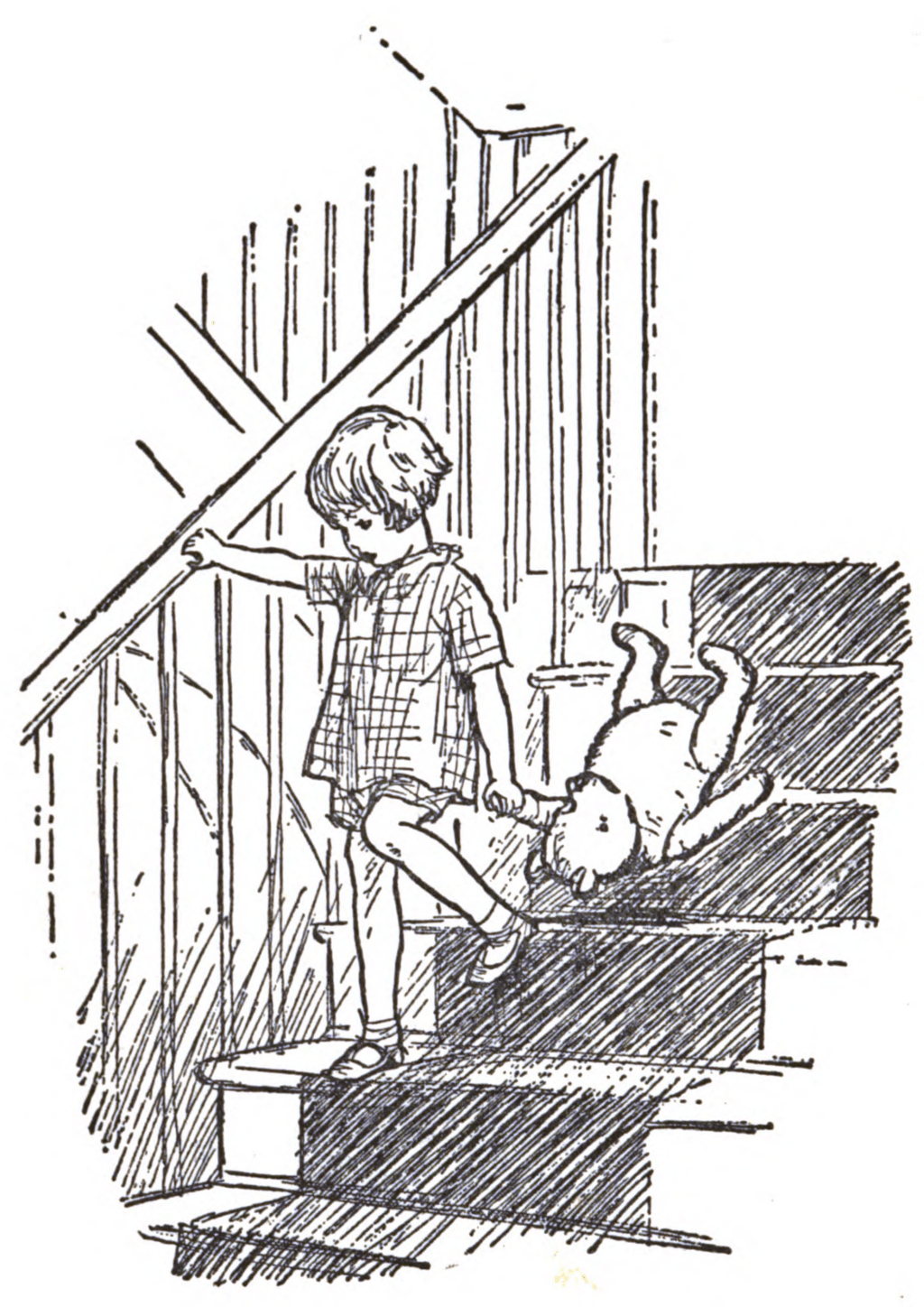
Ernest Howard Shepard, Public domain, via Wikimedia Commons
when the madness knocks at your door, my child,
never forget that your ancestors are butterflies
and the trees are your friends
I hate the ending of The House at Pooh Corner. I fall apart when Christopher Robin says goodbye to his friends in the enchanted forest because it’s time to grow up. I wept buckets over that ending as a child, and even today, I can’t think about it without tearing up. It’s awful. And one of the reasons it’s so awful, for me, anyway, is that it points to some big truths about what it means to grow up. And about that which we are forced to leave behind.
It’s a strange thing that we spend the first half (or so) of our lives trying to be everything we think we’re supposed to be and the latter half (or so) trying to undo it all and regain that which we lost along the way. And that is the feeling, at least in my experience—that something’s been lost and needs to be found. That’s why I started this blog 8 years ago: I woke up to the feeling that, while I was busy trying to live the life I thought I was supposed to live, I had lost something. There was an emptiness where something used to be. And I needed to figure out what that something was and get it back.
The Used Life is a document of my inward journey, which centered on developing my talents and exploring both new and long-forgotten interests. But that journey can look different for everyone. For some, it takes on religious connotations. Others literally set off on a journey. They change jobs, change homes, even travel the world in search of that which has been lost.
But what is it that we’re looking for? What exactly has been lost, and where has it gone? In my opinion, what’s been lost is our ability to experience the world like we did when we were children. When Christopher Robin says goodbye to the enchanted forest, he is saying goodbye to his ability to see the forest as enchanted. He is saying goodbye to his imagination and to that kind of holistic, childlike perception that brings seeing and imagining together. But more importantly, he is saying goodbye to the sensitivity that makes this possible. Because the journey he is about to embark on, the journey of growing up, will harden him and, in some sense, divide him so that he no longer has access to that original numinous perception.

It’s so easy when we’re children to experience the world as magical. All forests are enchanted. Sticks and stones are for collecting—because they’re magic, obviously. So are trees and butterflies and lightning bugs. (At sunset last night, my front lawn was covered in lightning bugs, and they are full of magic. I don’t care what anyone says.) When we’re digging in the dirt, we’re mining for treasure. We’re curious, and we’re full of wonder. And we create our own little myths and stories and rituals around everyday activities, and we act them out because that is what comes naturally.
And then we grow up, and the world loses its shine. And at some point, many of us find ourselves in the curious position of searching for an unnamable something to make our experience of the world and of ourselves feel more complete.
Do you know what I think happens? I think we become desensitized. I think we become desensitized by the harshness of reality, by human cruelty, exposure to violence, and overstimulation. But I also think we are desensitized by that which we repress. Our defense mechanisms may have the function of protecting us, but they also act as buffers against reality and against the deeper dimensions of consciousness. They render us incapable of experiencing our environment and ourselves as fully as we might otherwise be able.
That’s where that which is lost goes. It’s not on the other side of the world. It’s your shadow. Your imagination, your curiosity, your sense of childlike wonder, your belief in magic. It’s still in you. You just have to set it free. And that is much, much harder than journeying to the other side of the world. It’s a journey so difficult, in fact, that many never finish it, and some never even begin.
So how do we recuperate that which is lost? I’ve found that developing my skills and talents, big and small, is an excellent way. This is how we strengthen the Self, and when we strengthen the Self, our defenses start to fall away—sometimes in surprising ways. Engaging in personal myth-making and ritual is another way. The self-fashioning exercises I’ve been doing over the past several months have done wonders in terms of restoring dignity and meaning (and even a touch of magic) to my experience.
But there’s another way—and I touched on this yesterday—and that’s compassion. There is something alchemical about compassion. This is a lesson I learned from feeding the birds in my backyard. The more time I spent with them, the more I began to look on them not as objects, not as “other,” but as individuals. And more than that, as friends. Compassion has a way not only of opening our hearts, but also of tearing down a lot of the barriers our egos construct in order to protect us.
The isolation you find yourself in is a result of your ego. The world is alive and filled with creatures who have intelligence and who have soul, just like you. And they’re out there waiting to meet you, but you have forgotten how to meet them. Remember. Martin Buber says, “All real living is meeting.” Compassion opens the door to meeting.


 The Used Life


Leave a reply to Bob Cancel reply