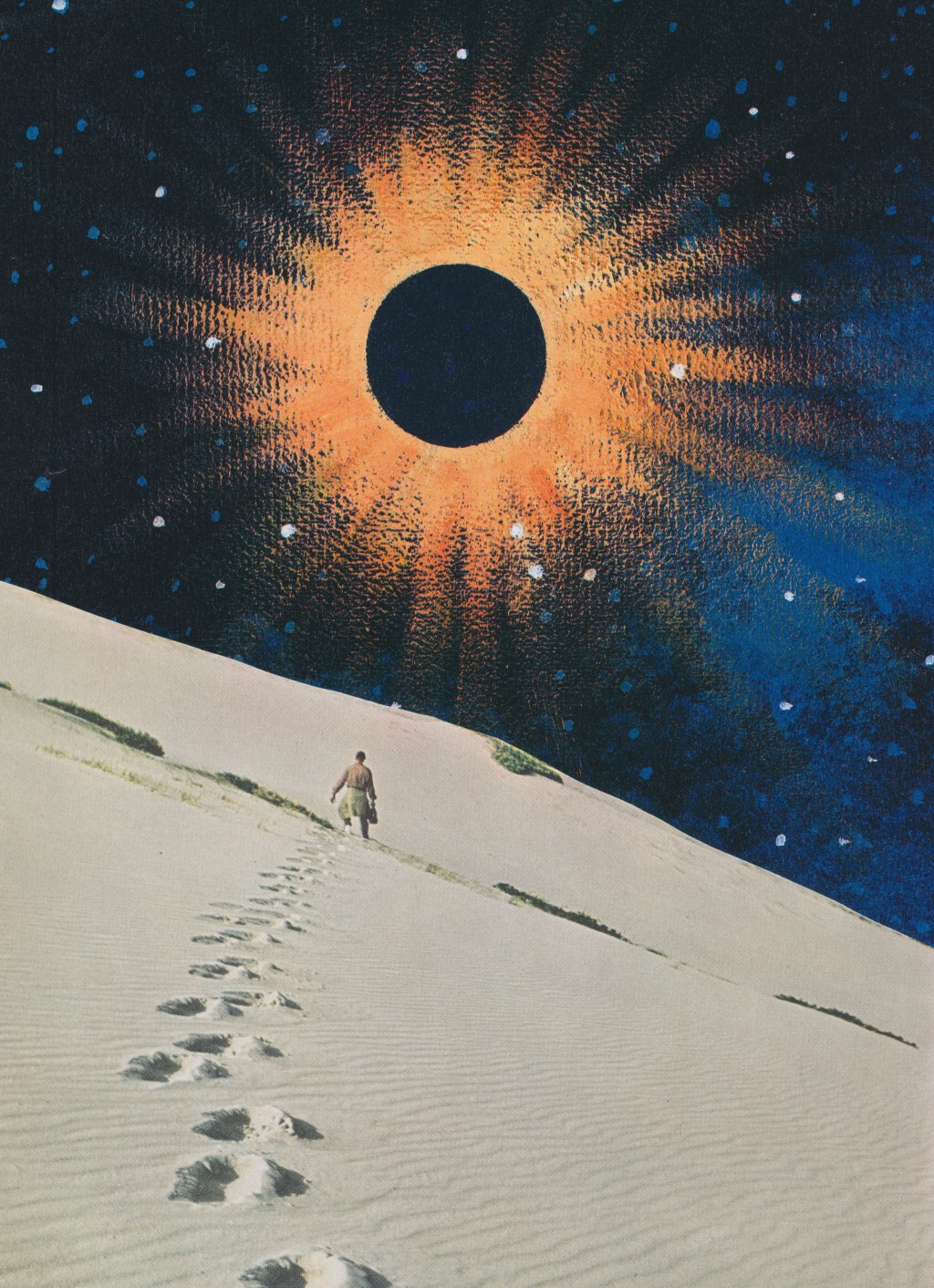
Find Your Star, paper collage, 2026
A compilation of thoughts, feelings, and reflections.
The illusions we have about other people are proportionate to the illusions we have about ourselves.
I am at once encouraged and extremely discouraged by humanity. If you are someone who is even minimally adept at reading other people, you probably understand my meaning. When you can discern others’ motivations, when you can see beyond their smiles and their niceness and the thin veil of their composure to the selfishness, the viciousness, the insecurity, the cowardice, or the capacity for cruelty that often lies beneath, you may want to sever contact with humanity altogether. To go out into the woods à la Thoreau and only have contact with the wild creatures forevermore. I know this feeling. And yet, I don’t act on it because I know goodness is possible. Perhaps not likely on a large scale, but possible. The possibility always exists that we can reach down to the depths of ourselves and unearth the kernel of goodness that lives there and use it to create the foundations for a life well-lived. Because that possibility exists, I remain an eternal optimist.
If the larger culture doesn’t offer you truth, goodness, warmth, compassion, knowledge, beauty, or respect, learn to be your own source. You are not deficient. All of these exist within you, or the capacity for them does. When you learn to be a source of light for yourself and others, the world opens up to you differently. You are not dependent on culture; you shape your reality with every decision you make. As Rollo May says, “Every human being must have a point at which he stands against the culture, where he says, this is me and the damned world can go to hell.”
We train our bodies and brains for performance, but we neglect our senses. Train your senses for looking and listening. The senses are tools for contemplation, for deeper awareness, and sustained attention.
There are moments in which we see patterns within ourselves that we cannot unsee, namely patterns of thought, behavior, speech, and habit that make us weak or that reflect an outdated version of ourselves. Once seen, it is almost impossible not to take action, not to stand up to (or for) oneself and say, “Enough. This is not who I am or who I want to be.” This is what it means to confront your own shadow.
We often forget that our words and actions inform our self-perception. If I habitually speak or act in a way that is beneath me—say, if I gossip or speak negatively about other people—then I am telling myself that behavior is permissible. Every time I gossip about someone, I am quietly reinforcing the idea that “this is who I am”. Don’t allow yourself to speak or act in a manner that is beneath you.
It is my experience that sometimes the best shadow work we can do is strengthen the Self. That is, shadow work doesn’t always have to mean descending into our own darkness. It can also mean strengthening our own light. It can look like “following our bliss,” as Joseph Campbell says. That means exploring our talents, actualizing our potential, finding what brings us joy, satisfaction, and a sense of meaning, and doing more of it. It means acting in such a way that I feel “this is what I was made to do.” That feeling is a feeling of alignment with our own souls, and the more we pursue it, the stronger it gets. It is my experience that the shadow recedes in proportion—bad behaviors, toxic patterns, and most importantly, the need for them start to disappear–and often in surprising ways.
Practice sitting in nature and observing without judgment. Then, apply this same practice to yourself.
Only 16% of Americans read for pleasure on any given day. Approximately 30% of American adults cannot make inferences or paraphrase ideas from a long-form text, and 54% of U.S. adults read below a 6th-grade level. We are perhaps entering or have already entered an age of “post-literacy”. This is terrifying for any number of reasons, none the least of which is this: if you cannot read, you are the easiest person in the world to control.
Now more than ever, it is imperative that we take responsibility for our own education and for the development and maintenance of our talents and skills. Read books—long and challenging ones. Look up unfamiliar words. Reflect on ideas. Retrain your attention span. Practice working with your hands: garden, draw, collage, keep a journal. Cook. Create. Move your body. Live a human-centered life.
While the rest of the world is using AI and listening to audiobooks, I would be proud to be the last person on the planet curled up in the corner of a library with a cup of tea and a dusty volume of Jane Eyre or The Count of Monte Cristo. That is a hill I am prepared to die on.


Leave a Reply