
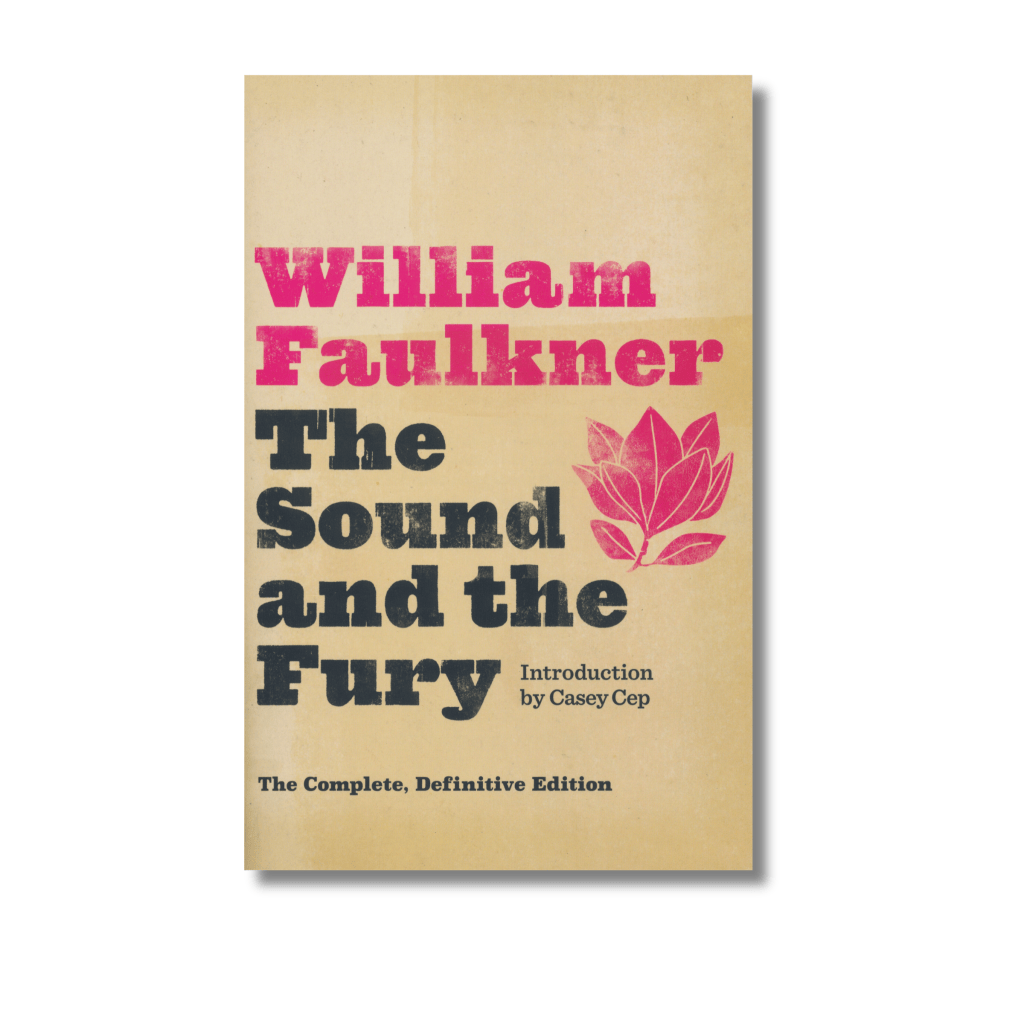
William Faulkner’s The Sound and the Fury chronicles the demise of the once established Compson family. In a word, I would describe this novel as “devastating,” yet not entirely without consolation or hope. The story is set in rural Mississippi and is divided into four sections, each with a different narrator, spanning the period 1910-1928.
The four narrators, Benjy, Quentin, and Jason, the three Compson brothers, as well as Dilsey, the family’s housekeeper, are at the center of the novel, and it is on my impression of each narrator that I would like to focus this review. For me, the genius of this novel resides in both the construction of the four narratives, as well as the personalities and voices of the narrators. All are not only a testament to Faulkner’s keen understanding of human nature, but also his ability to create complex, profound, and timeless characters who are capable of eliciting a full range of emotions and even soul-searching within the reader.
The first narrator is Benjy. He is the Compsons’ youngest son. He also has a mental disability. Both Benjy’s narrative and his brother Quentin’s are examples of Faulkner’s experimental style. That is, Benjy’s narrative isn’t quite linear. Occasionally, crucial details or context are partially or wholly omitted, as in the first paragraph, in which he describes a game of golf by saying, “They took the flag out, and they were hitting.”
Past and present often intermingle in Benjy’s narrative without forewarning. It is sometimes difficult to distinguish between events that are being recalled from memory and those that are taking place in real time. I know this kind of nontraditional or experimental storytelling can be off-putting for some readers, but I think it’s an important part of what makes this novel so powerful. That is, the experimental prose segments provide crucial insight into the way the characters think and perceive the world. And that’s an effect that I don’t think could have been achieved through traditional methods.
Benjy is treated callously by most of his family; although, he doesn’t quite comprehend it. The most powerful depictions of Benjy, for me, come from Dilsey’s narrative, which is the fourth and final section of the novel. There is, however, a good bit of foreshadowing toward the end of Benjy’s own narrative (I am trying to avoid spoilers, so I’ll remain vague about the details) that made me think, “Benjy is going to break my heart.” I wasn’t wrong about that. There is a tragic, if not gut-wrenching, end to Benjy’s story. And yet, I’ll say this: while the culmination of Benjy’s story wasn’t a surprise to me, I actually think Faulkner softens the blow. It could have been worse—and in fact, worse was what I had been expecting.
The second narrator is Quentin. We meet Quentin in 1910 when he is a student at Harvard. His narrative, like Benjy’s, is told largely in experimental prose, especially his quasi-philosophical meanderings. These sections can be a bit difficult to get through, but my advice is not to skip them. They are not without meaning. Many are poignant and lyrical, and they absolutely give us insight into Quentin’s state of mind.
I neither really liked nor disliked Quentin. Nor did I feel much in the way of sympathy or compassion for him. I rather thought he was a troubled soul who met an aptly troubled end, and his narrative left me with more questions than answers. With regard to him and his sister, Caddy, there is a question of incest. For clarity on this question, it’s imperative you read the appendix.
Jason is the third and most provocative narrator. He is also the character to whom I had the most visceral, complex, and lingering emotional response. The first line of his narrative is, very appropriately, “Once a bitch always a bitch…” Jason is a bitter, spiteful, cruel, and altogether nasty piece of work. And yet, I can understand why he is the way he is.
The best adjective I can think of to describe Jason is “pathetic.” He hates the life he’s living and is resentful because the life he had been promised tragically slipped through his fingers. He is a man who has been stunted. His behavior is often cruel and inexcusable, yet there is a pitiable creature beneath the contemptible exterior. It’s as if his whole being is so filled with horrible emotions, he can’t possibly find enough places to unload them all. I was blown away by Faulkner’s ability to create a character like Jason.
The fourth narrator is Dilsey, the Compson family’s housekeeper. She is Black, and she and her family live on the Compson family property. Dilsey is one of the only characters who displays any kindness and compassion towards Benjy, and those scenes that show Dilsey caring for him are among the most moving in the novel, for me, anyway. Caroline, the Compson family matriarch, predictably treats Dilsey as an inferior, with callousness and indifference. I found it impossible not to feel compassion for Dilsey, as well as admire her resolve.
It is worth noting, too, that Caroline Compson was my least favorite character in The Sound and the Fury. As far as I’m concerned, she has no redeeming qualities. Caroline is every bit a narcissist. Benjy is God’s way of punishing her. Her daughter Caddy’s indiscretions are also her God-given burden to bear. Jason is the good son because he is just like her. Everything is about her. She is, to my mind, pretty much unforgivable.
My final thoughts on this novel: it is complex and exquisite and absolutely worth reading.


Leave a Reply